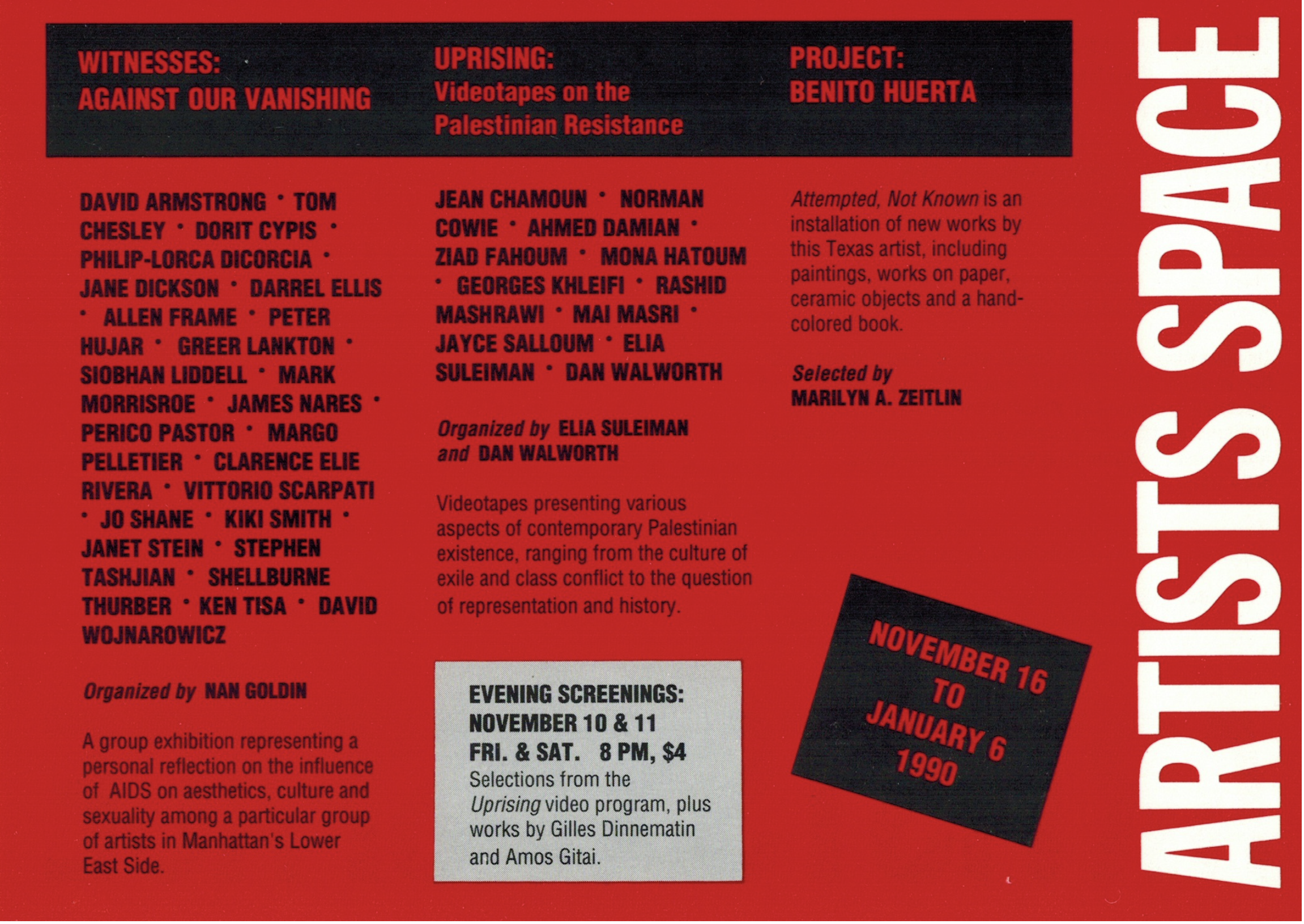
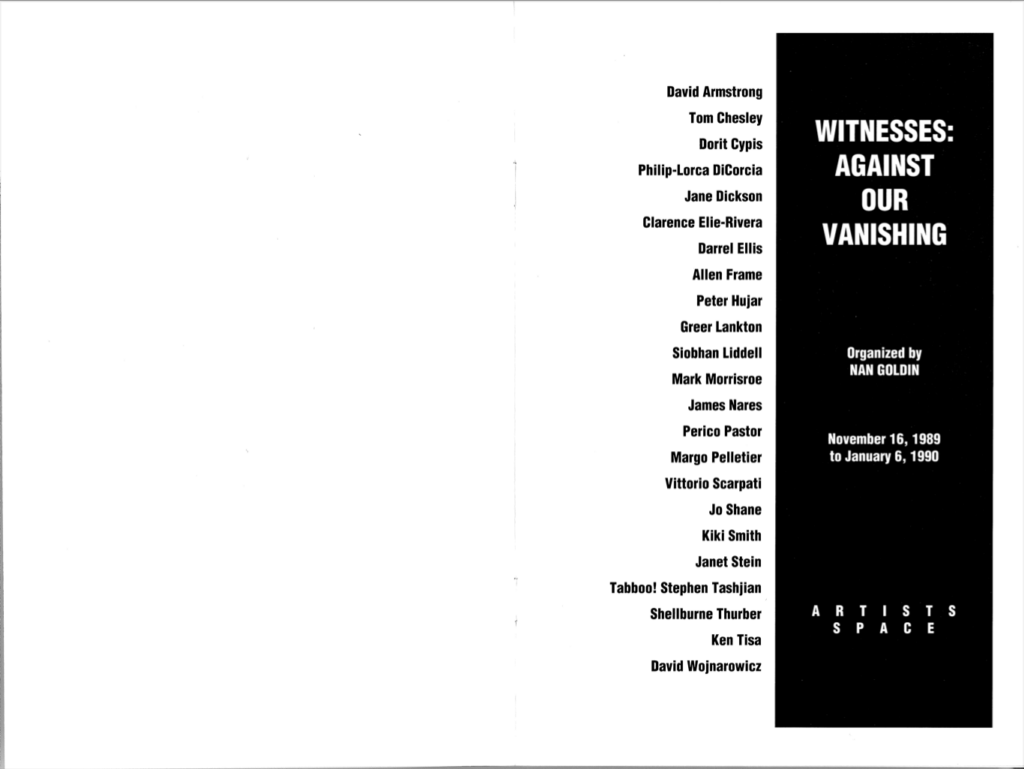
On November 16, 1989, Witnesses: Against Our Vanishing opened at Artists Space in New York City. The group exhibition, curated by photographer Nan Goldin, included almost one hundred works by twenty-five artists. This close network of artist friends had watched as their community was ravaged by the AIDS epidemic and by prejudiced societal responses. The exhibition was dedicated to those recently lost to AIDS, in particular Kenny Angelico, Keith Davis, Max diCorcia, Peter Hujar, Mark Morrisroe, Vittorio Scarpati, and Bibi Smith.
In a 1990 interview with arts scholar Steven Dubin, David explained how he came to participate in the show:
“Nan [Goldin] said she was curating a show dealing with AIDS among her friends, which I thought sounded beautiful. I’d be glad to be a part of whatever Nan does from now till the end of the next century. We talked about looking at how this disease was dealt with by a group of people who had died from it, and other people who had watched them die. Given who my friends are, it’s like these threads that come together. She asked me to put some work into this show, and I said sure. She asked me if I’d be interested in writing one of four essays. I said sure. “(Wojnarowicz 1990)
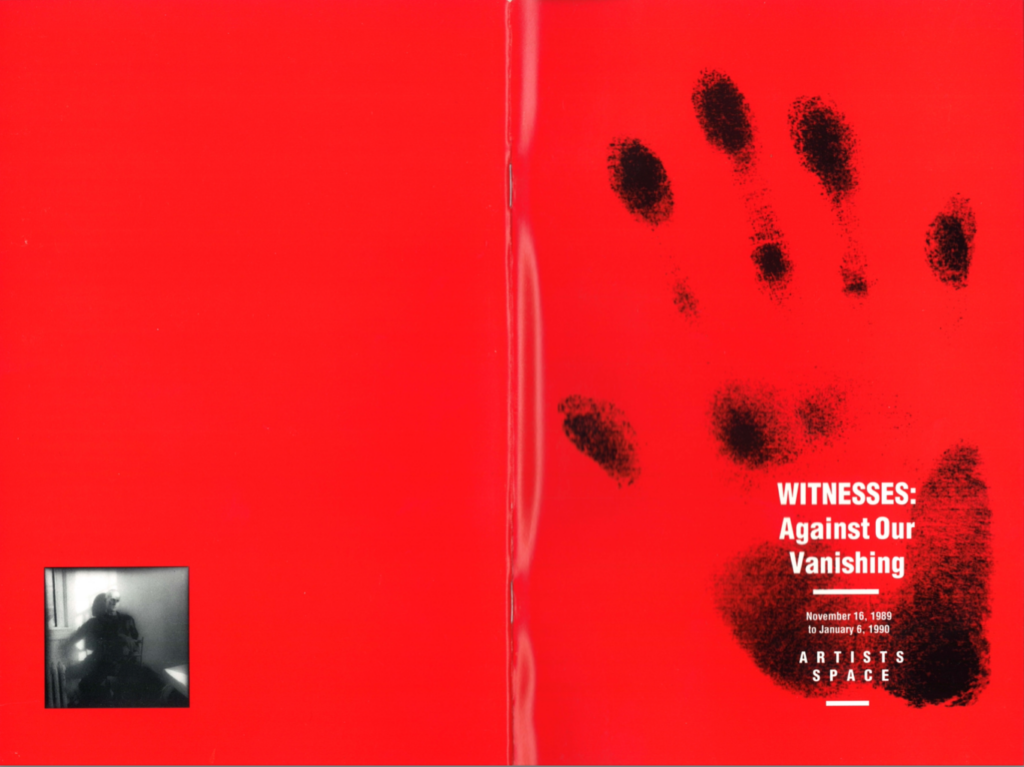
“Witnesses: Against Our Vanishing” invitation. New York: Artists Space, 1989.
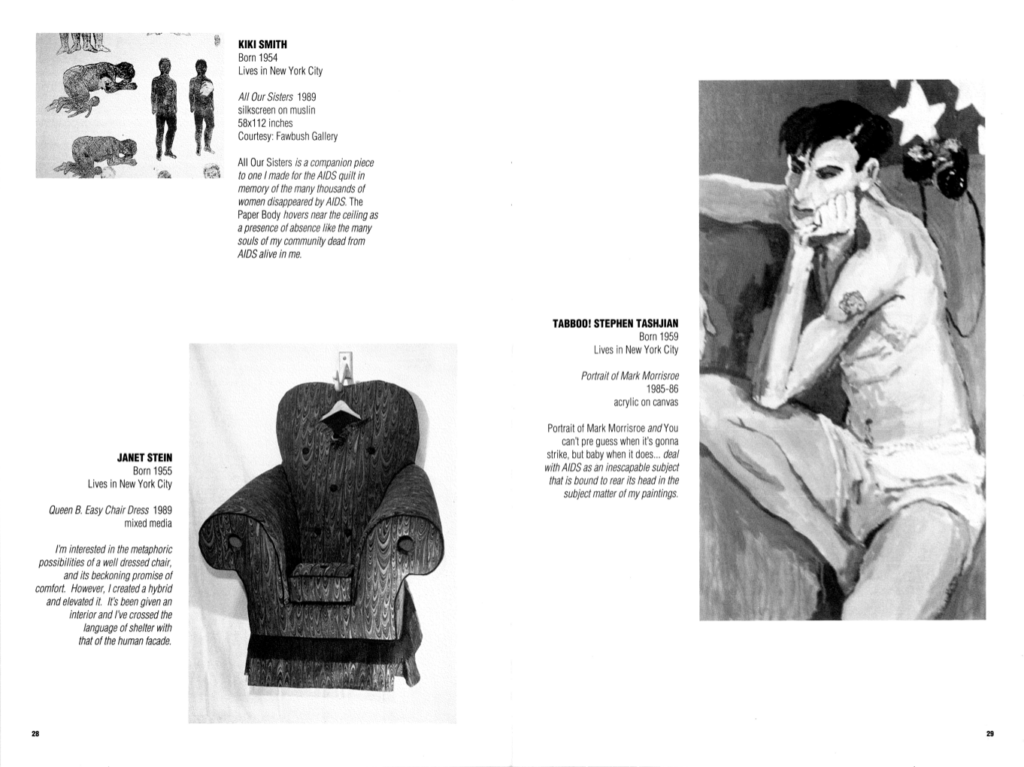
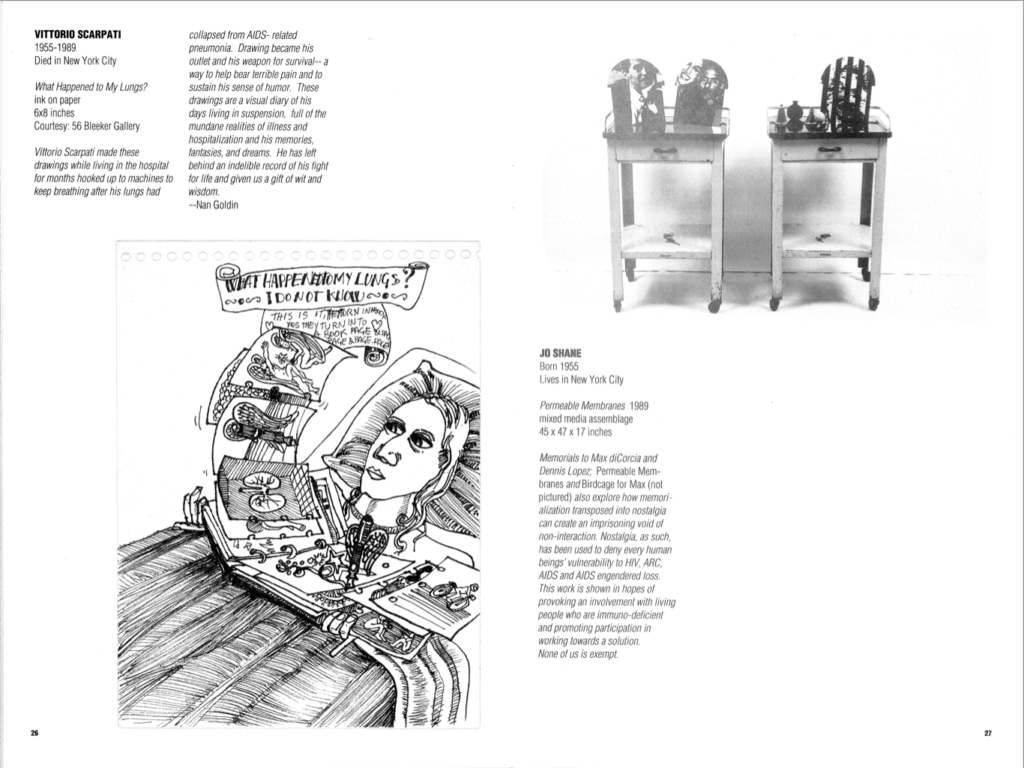
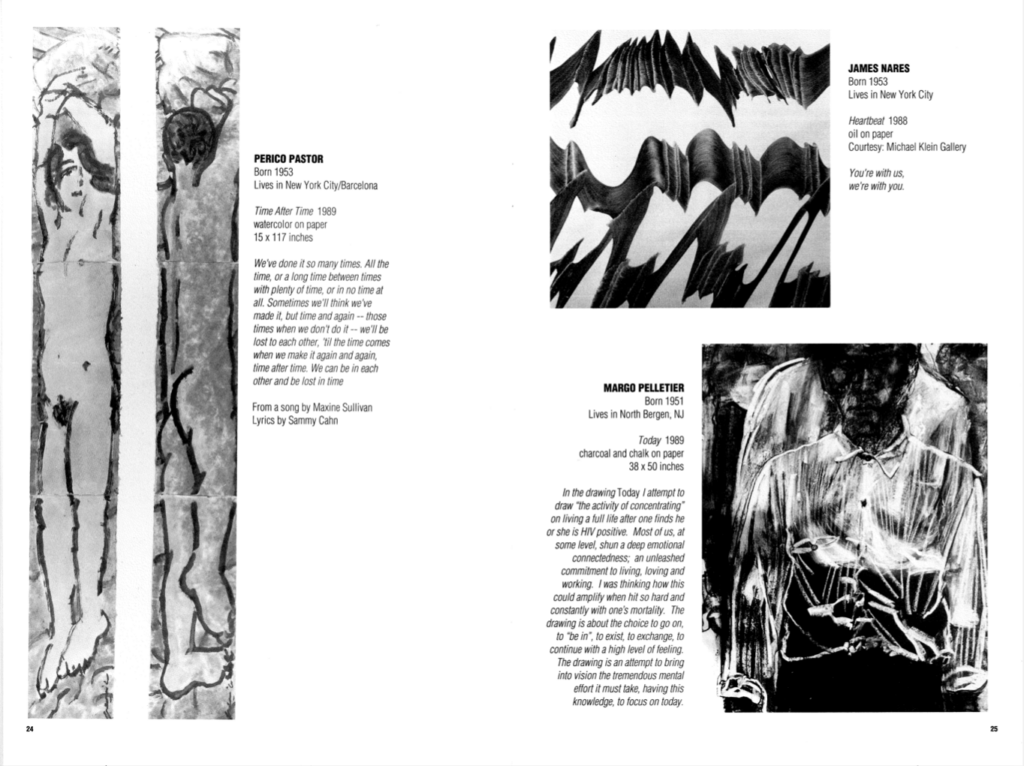
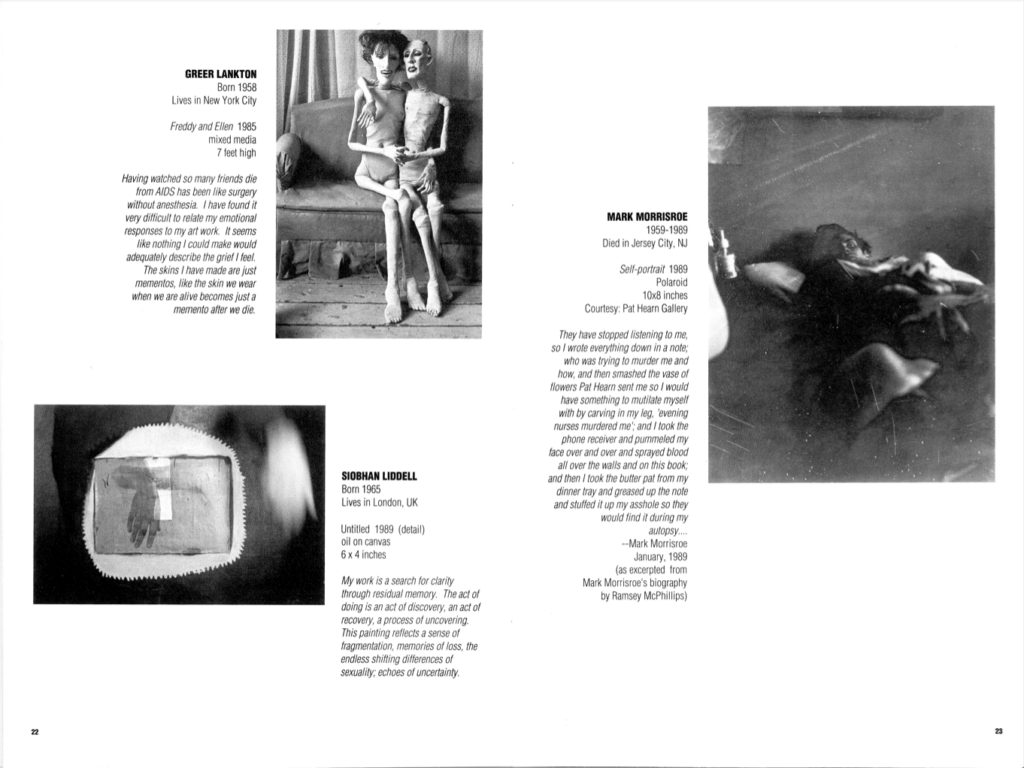
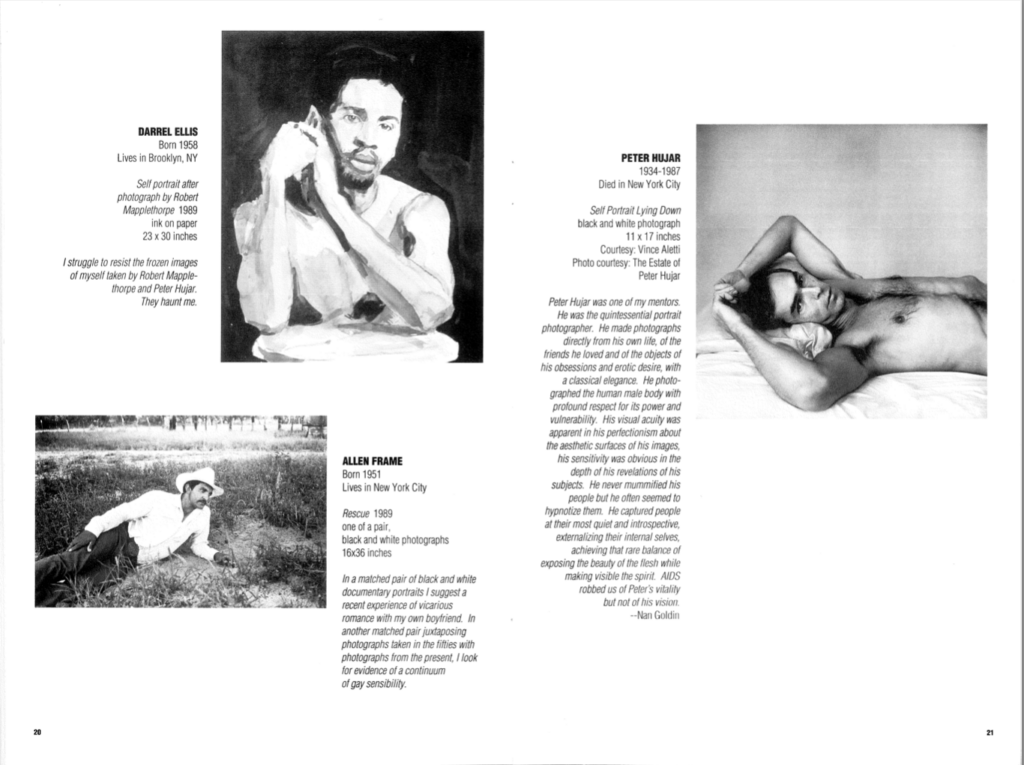
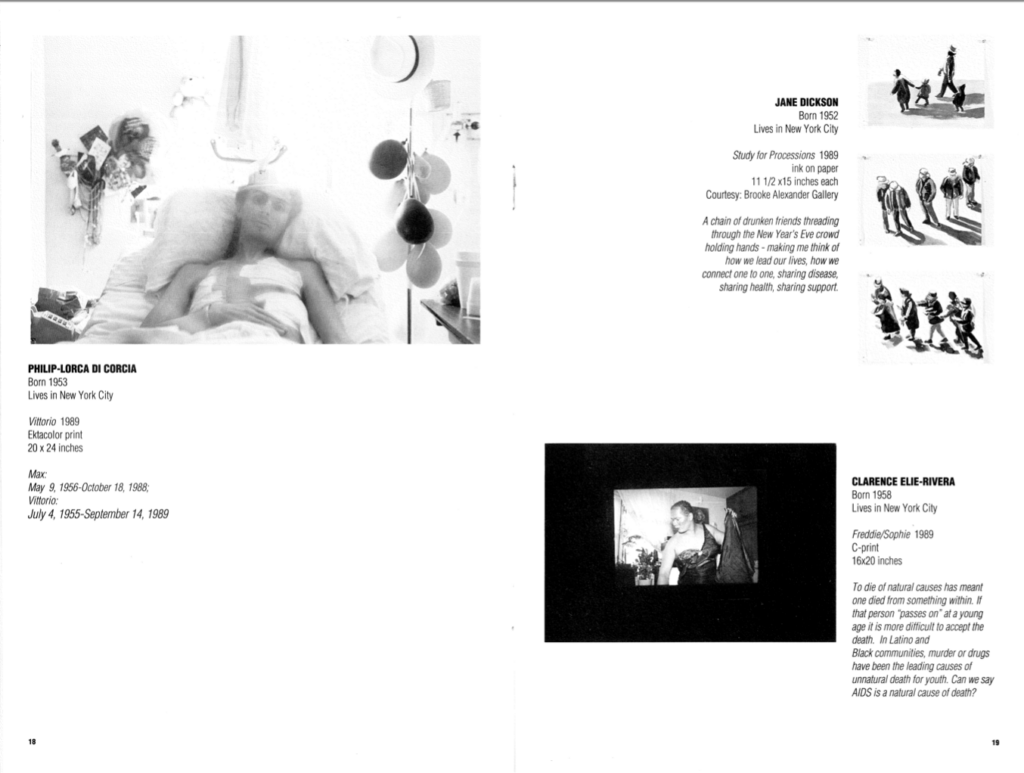
The artworks presented in Witnesses were less explicitly protest art, and more “testimony of survival” (Wyatt, Witnesses pg. 2), speaking to the realities of continuing to lead one’s life even as friends and lovers died and repression worsened. A total of 39 photographic portraits were presented in the show, serving as documentation of life, honoring of subjects, and in some cases, as memorials. References to one another were present throughout, including eight portraits representing artists in the show (Armstrong, diCorcia, Ellis, Hujar, Morrisroe, Tabboo!, and Wojnarowicz), emphasizing the position of the group of artists as interconnected, and their work as reflective of their lived experiences as part of this community.
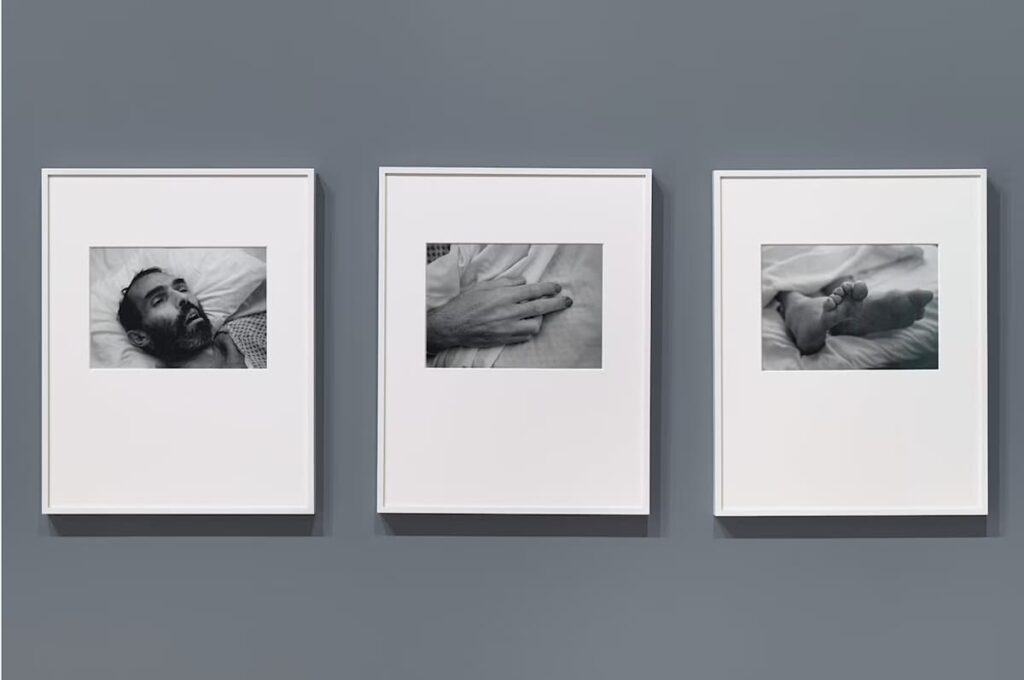
Untitled (Peter Hujar), 1987. Gelatin silver prints 10 1/4 x 14 3/4 in.
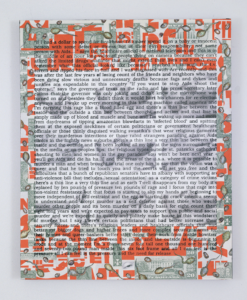
Untitled (Hujar Dead), 1988-89. Gelatin silver print, acrylic, screenprint, and collaged paper on board, 39 1/8 × 32in.
Among these portraits were two artworks by David: a triad of photographs of Peter Hujar’s face, hand, and feet, taken directly after his death from AIDS, and a collage using the same photographs, repeated and overlaid with fragments of money, illustrated sperm and t-cells, and an excerpt from David’s essay, Do Not Doubt the Dangerousness of the 12-Inch-Tall Politician.
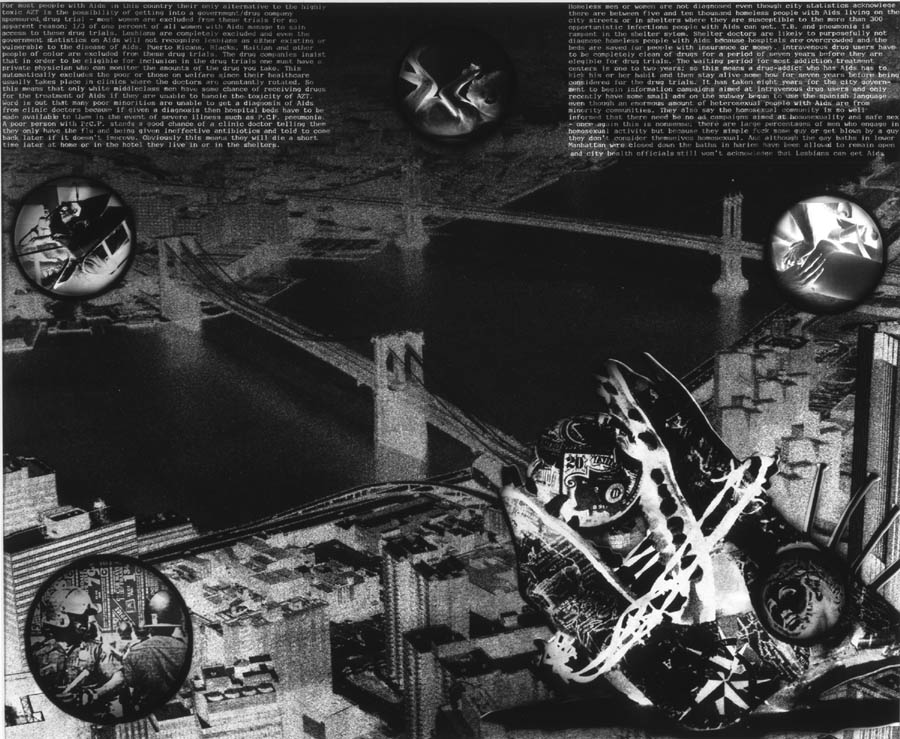
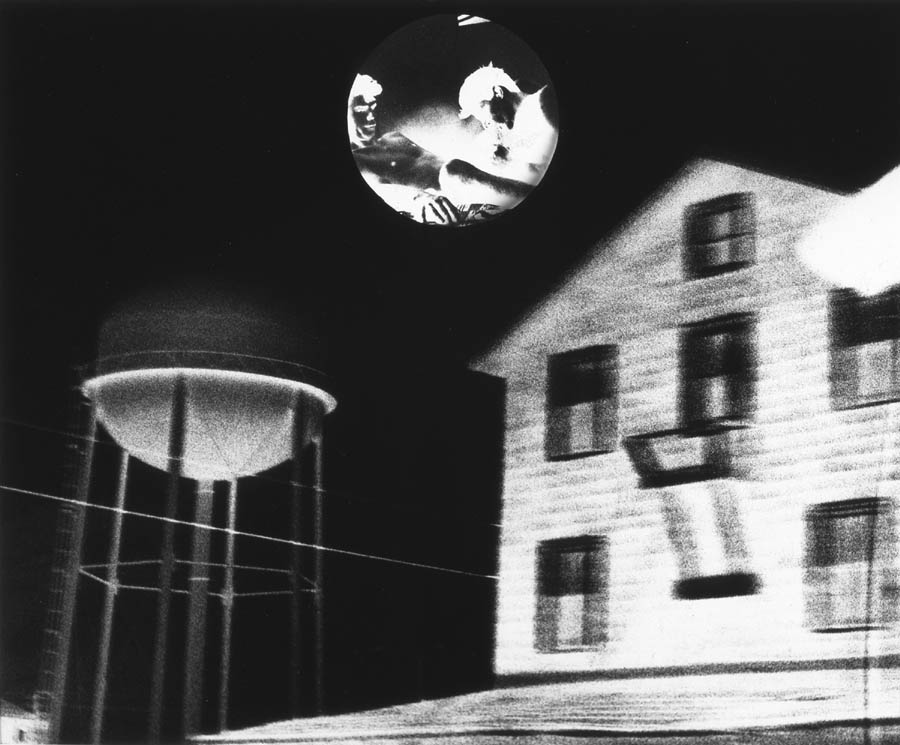
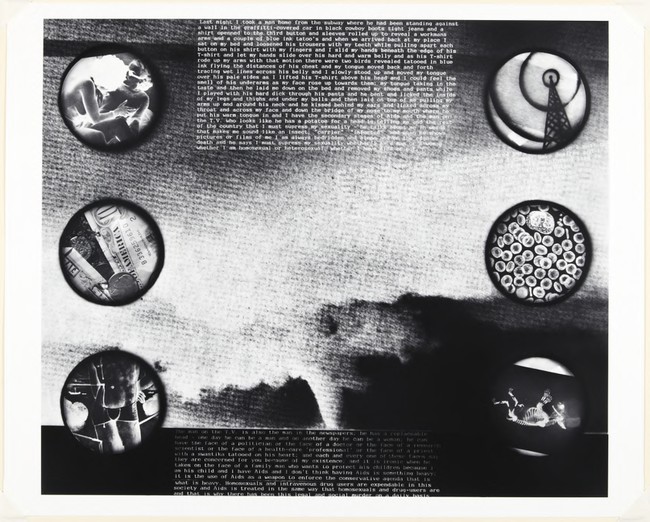
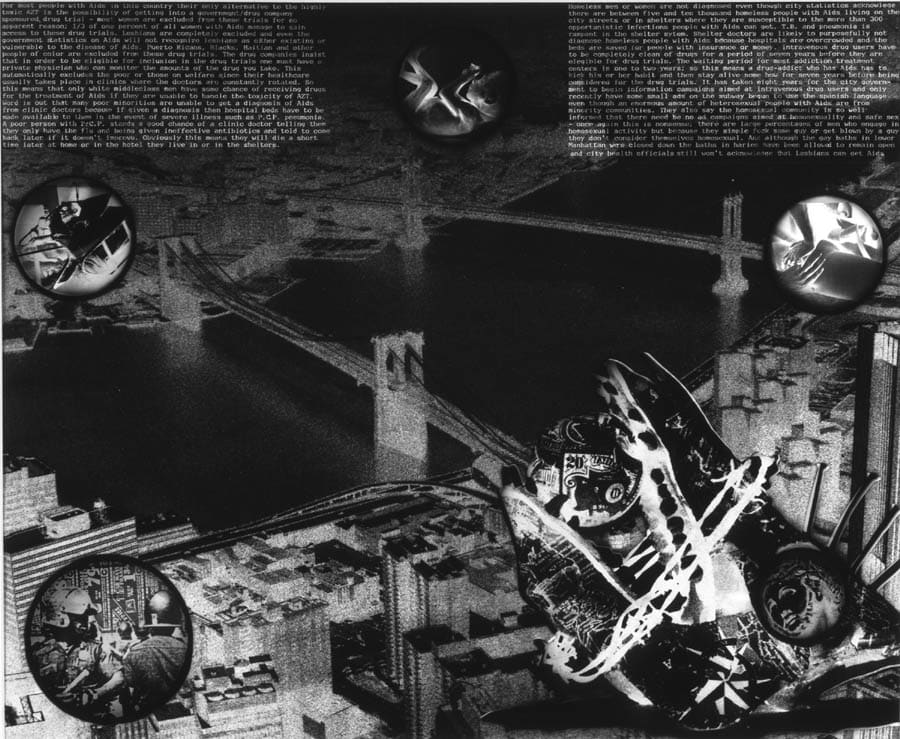
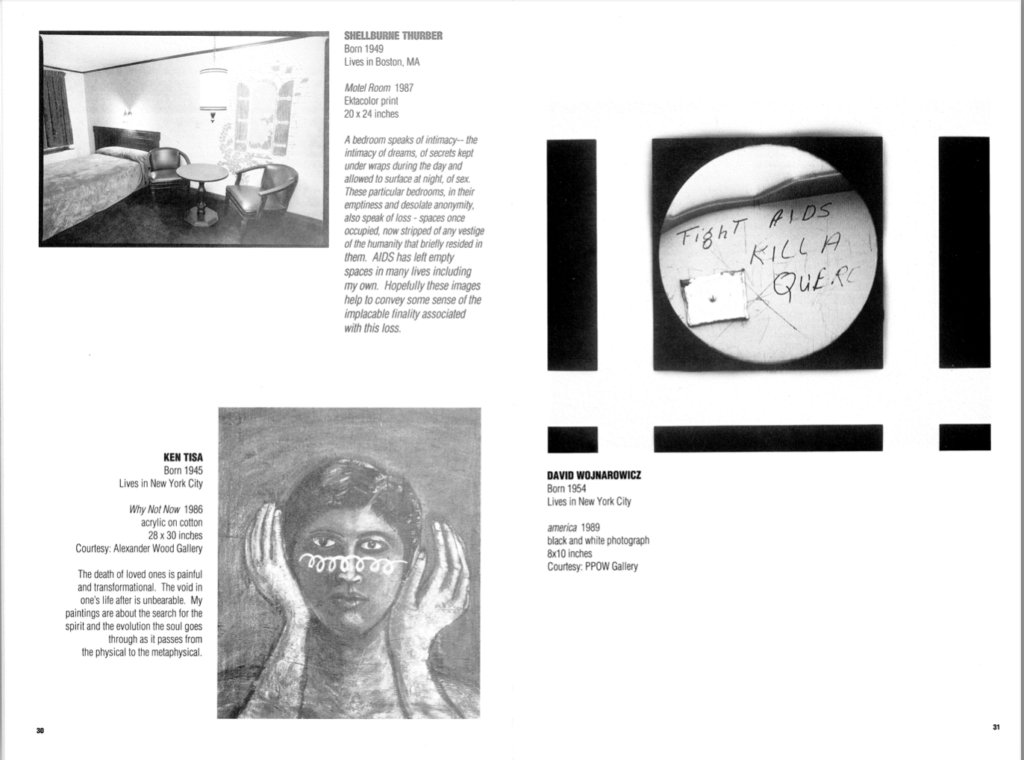
Four prints from David’s Sex Series (for Marion Scemama) were also exhibited, featuring collaged photographic negatives of protests, American infrastructure, gay pornography, blood cells, military technology, and newspaper headlines. Placed in the same room in the gallery as seven photographs by Peter Hujar, David’s work responded to his relationship with Hujar and his death through careful memorialization and outrage, dually engaging the social and documentary dimensions of Hujar’s preferred medium. Photographs in Witnesses were thus shown to be a means of interacting with and caring for one another, while also bearing urgency in their expression to viewers. These photographs affirmed the bodily presence and lived realities of those obscured from mainstream discourse for their sexualities, memorializing those represented while calling on viewers to take action towards queer survival.
Untitled, Sex Series (for Marion Scemama), 1989. Gelatin silver print, 16 × 20 in.
Untitled, Sex Series (for Marion Scemama), 1989. Gelatin silver print, 16 × 20 in.
Untitled, Sex Series (for Marion Scemama), 1989. Gelatin silver print, 15 13/16 x 19 7/8 in.
Untitled, Sex Series (for Marion Scemama), 1989. Gelatin silver print, 16 × 20 in.
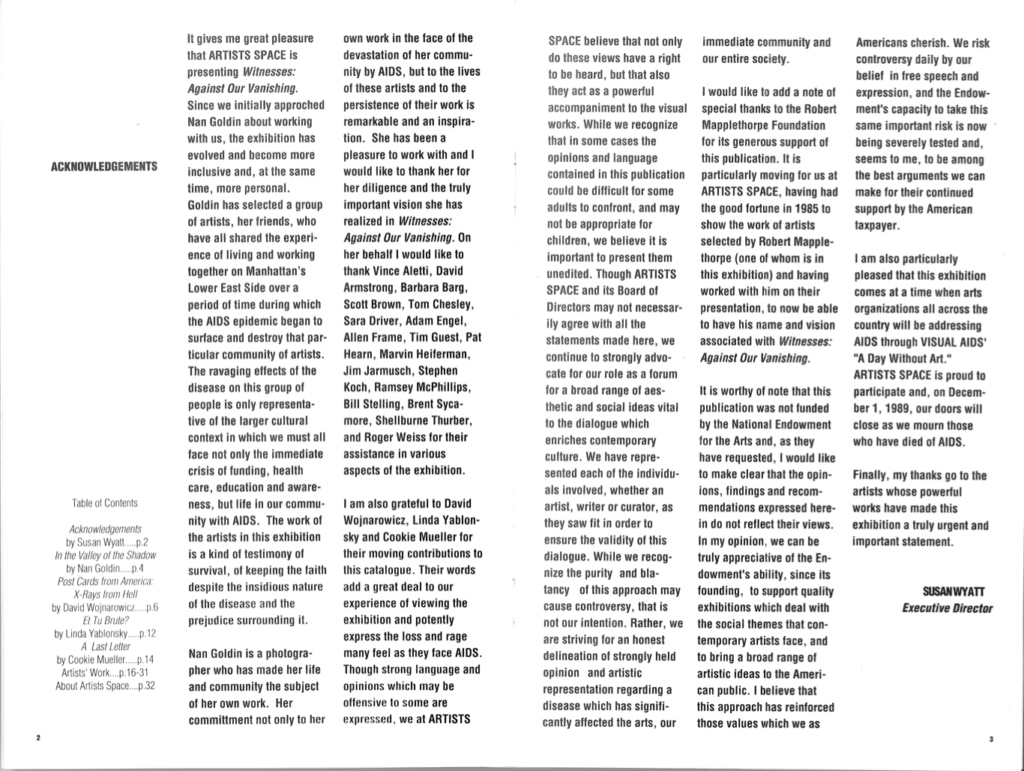
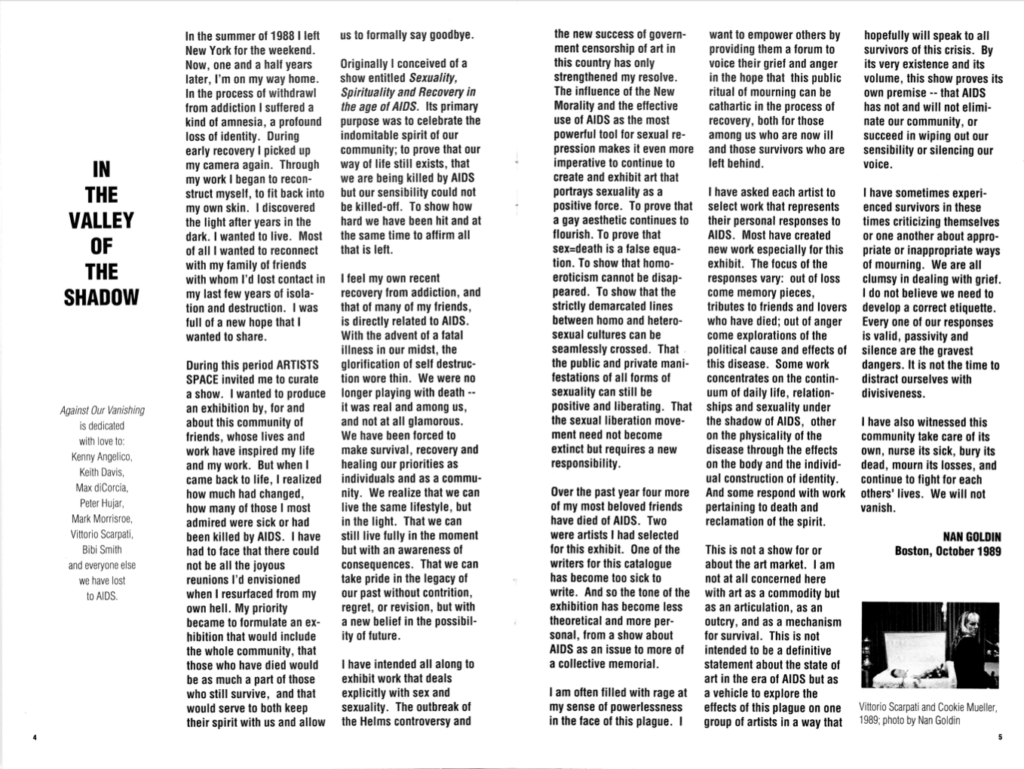
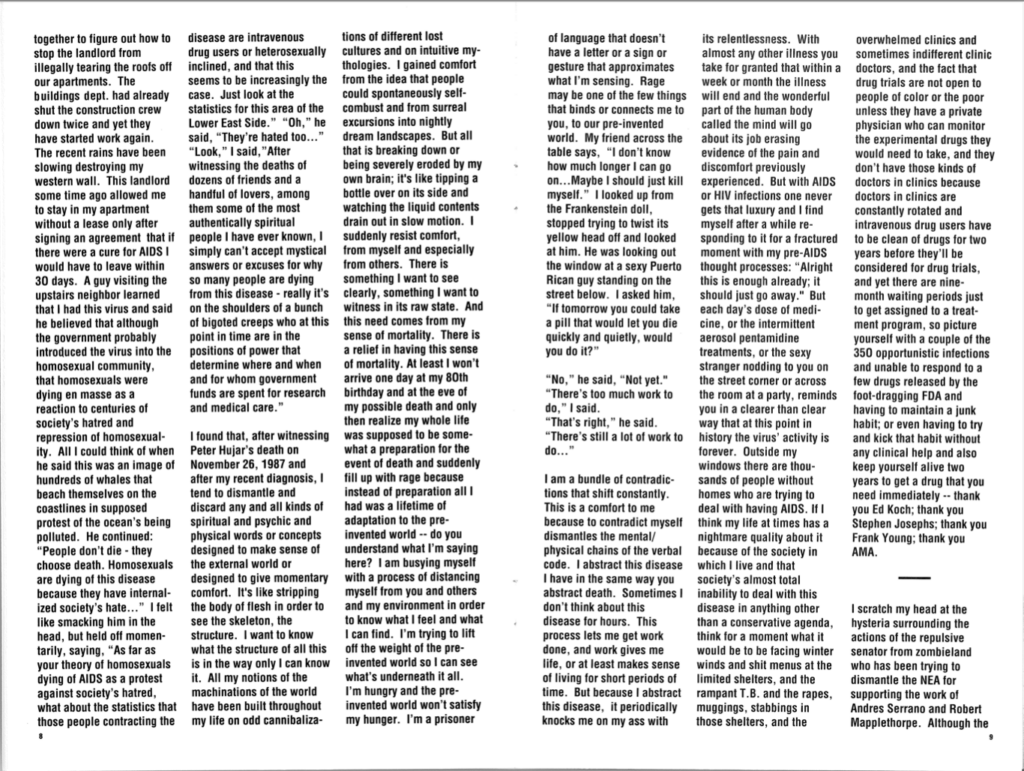
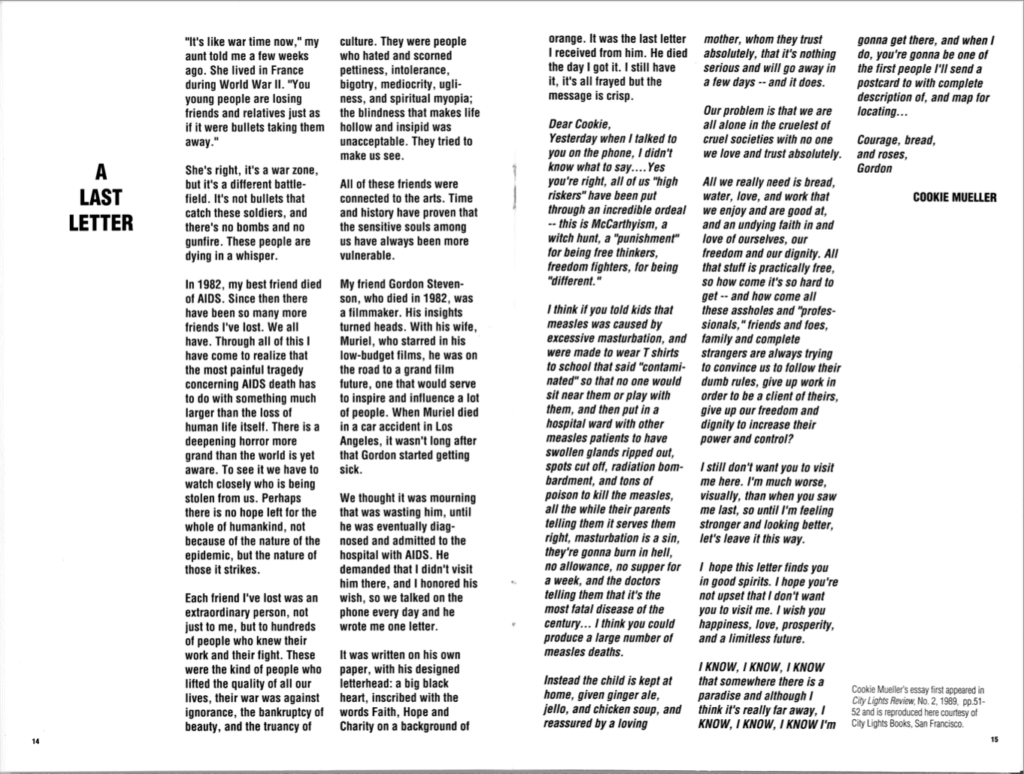
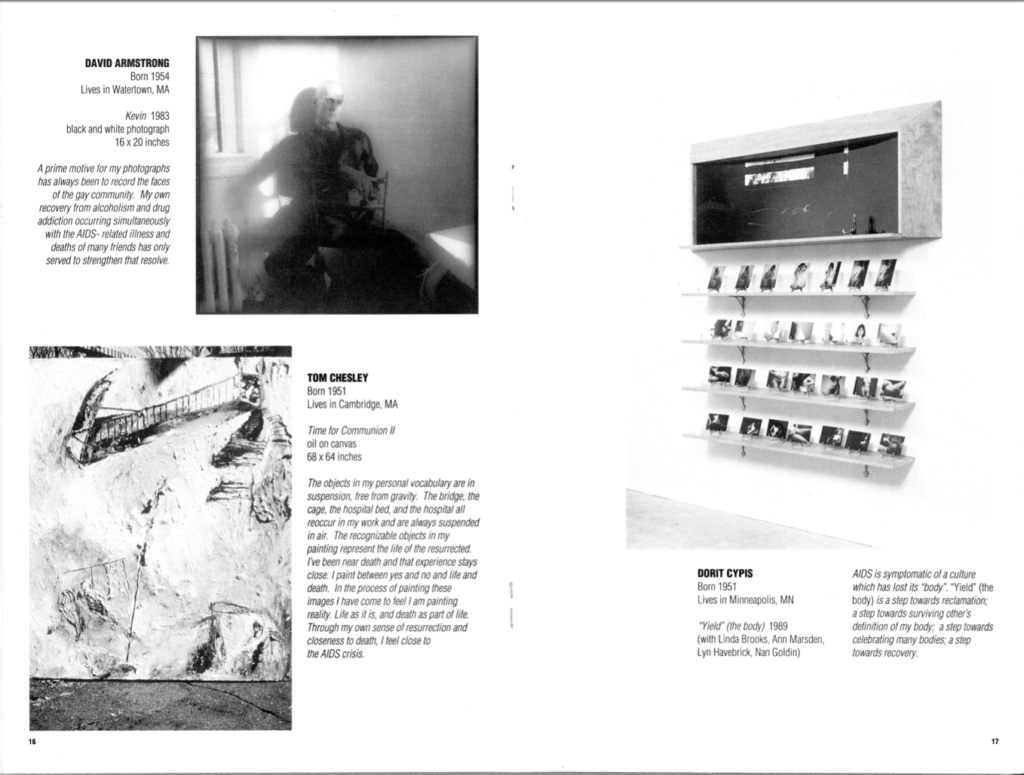
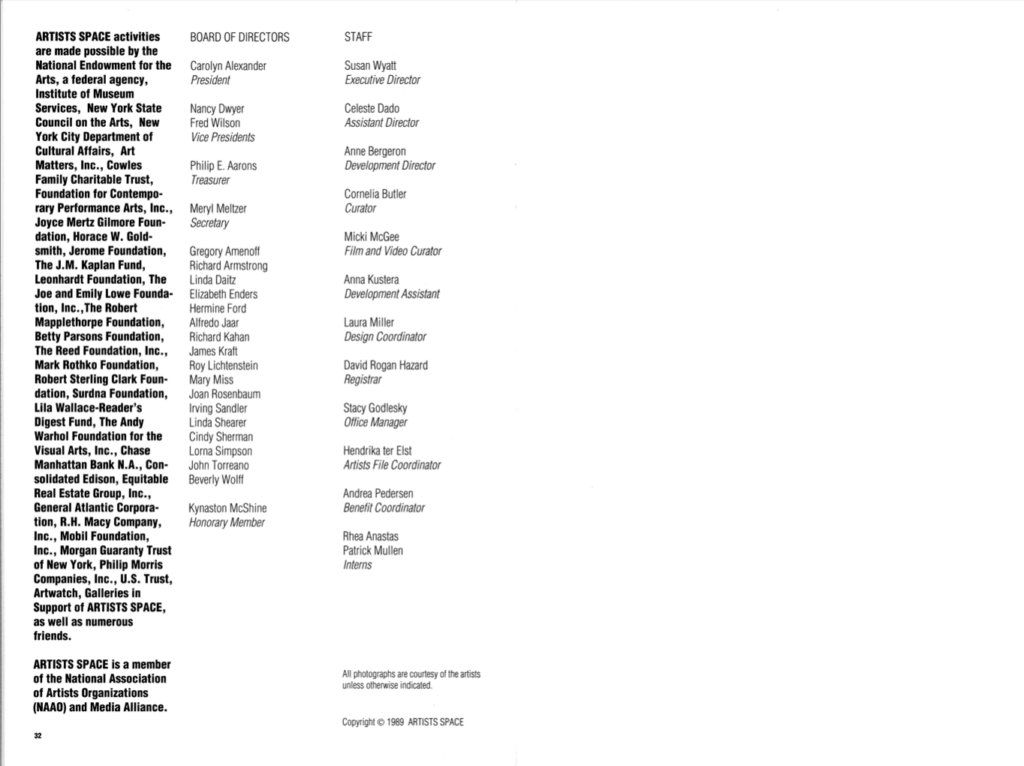
Prior to the exhibition opening, a catalogue was published, featuring each artist’s work and a short statement about its relation to AIDS. Text included acknowledgements by Artists Space Executive Director Susan Wyatt, an introduction by Nan Goldin, essays by David, art critic Linda Yablonski, and Cookie Mueller (who, too ill from AIDS to write, contributed her essay A Last Letter first published in City Lights Review, No 2, 1989). Mueller died of AIDS-related causes on November 10th at age 40, just six days before the show’s opening.
Nan Golden, Witnesses: Against Our Vanishing, catalogue. New York, Artists Space, 1989.
Nan Golden, Witnesses: Against Our Vanishing, catalogue. New York, Artists Space, 1989.
Nan Golden, Witnesses: Against Our Vanishing, catalogue. New York, Artists Space, 1989.
Nan Golden, Witnesses: Against Our Vanishing, catalogue. New York, Artists Space, 1989.
Nan Golden, Witnesses: Against Our Vanishing, catalogue. New York, Artists Space, 1989.
Nan Golden, Witnesses: Against Our Vanishing, catalogue. New York, Artists Space, 1989.
Nan Golden, Witnesses: Against Our Vanishing, catalogue. New York, Artists Space, 1989.
Nan Golden, Witnesses: Against Our Vanishing, catalogue. New York, Artists Space, 1989.
Nan Golden, Witnesses: Against Our Vanishing, catalogue. New York, Artists Space, 1989.
Nan Golden, Witnesses: Against Our Vanishing, catalogue. New York, Artists Space, 1989.
Nan Golden, Witnesses: Against Our Vanishing, catalogue. New York, Artists Space, 1989.
Nan Golden, Witnesses: Against Our Vanishing, catalogue. New York, Artists Space, 1989.
Nan Golden, Witnesses: Against Our Vanishing, catalogue. New York, Artists Space, 1989.
Nan Golden, Witnesses: Against Our Vanishing, catalogue. New York, Artists Space, 1989.
Nan Golden, Witnesses: Against Our Vanishing, catalogue. New York, Artists Space, 1989.
Nan Golden, Witnesses: Against Our Vanishing, catalogue. New York, Artists Space, 1989.
David’s contribution, an essay titled Postcards from America: X-Rays from Hell, described his personal experiences and everyday realities of living as a person with AIDS.The essay’s inspiration came from a moment he shared with his friend and collaborator Phil Zwickler, as Zwickler paced around David’s loft ranting nervously about his own T-cell count while David reflected on the newspaper headlines spread across his kitchen table announcing the advance of homophobic public policies. In alignment with Goldin’s curatorial stance, David posited that it was existentially and politically necessary to make queerness visible in society through artistic representations of non-heteronormative sexuality.
By countering dominant narratives of queer sexual deadliness, irresponsibility, and perversion, he argued that his community could work to honor and memorialize one another while fighting for recognition and social change. Here he first verbalized his pioneering idea of public grief as protest:
“to turn our private grief at the loss of friends, family, lovers and strangers into something public would serve as another powerful dismantling tool. It would dispel the notion that the virus has a sexual orientation or the notion that the government and medical community has done very much to ease the spread or advancement of this disease” (Wojnarowicz, Witnesses pg. 11).”
In making their grief public, David asserted that his community could counter their social invisibility and fight against the hegemony perpetuating their destruction.
“I wrote an essay dealing with image, identity, invisibility, representation, media and health and everything seen through the framework of having a taboo disease in this society... ” —David Wojnarowicz
David’s catalogue text railed against governmental indifference to mass civilian deaths. In expressing his anger with a society that refused to “deal with mortality”, he named homophobic public figures including John Cardinal O’Connor, Senator Jesse Helms, and the Reverend Donald Wildmon, suggesting that their actions would soon cause desperate, grieving people to make violence against them (Wojnarowicz, Witnesses pg. 7). David also decried art institutions’s acquiescence to governmental censorship in a nod to then-raging debates about National Endowment for the Arts (NEA) funding.
The Helms Amendment, introduced by Senator Jesse Helms (R, NC) in 1989, denied NEA funding of artists whose work was deemed “indecent” for public American standards. Following Miller v. California (1973), the United States government defined artwork as obscene when it fulfilled all three of the following: 1. The average person, applying contemporary community standards, would find that the work, taken as a whole, appeals to prurient interest, and 2. the work depicts, or describes, in a patently offensive way, sexual conduct specified by the statute, and 3. the work, taken as a whole, lacks serious literary, artistic, political, or scientific value (Miller v. California, 1973, pg. 24). This typically included artworks that discussed, explicitly or implicitly, queer sexuality, political unrest, anti-church sentiment, or other forms of societal nonconformity. David explained that museums and galleries were engaged in “selective cultural support and denial”, enacting the same forms of censorship regardless of The Helms Amendment due to a pervasive deference to “white straight male erotic fantasies” (Wojnarowicz, Witnesses pg. 10). The solution to such censorship and its adverse effects on the queer body in crisis was then visual definition, assertions of presence and endurance in the face of erasure and indifference.
Phil Zwickler, Interview with David Wojnarowicz, 1989 on exhibition “Witnesses Against our Vanishing.” Courtesy The Phil Zwickler Charitable and Memorial Foundation Trust.
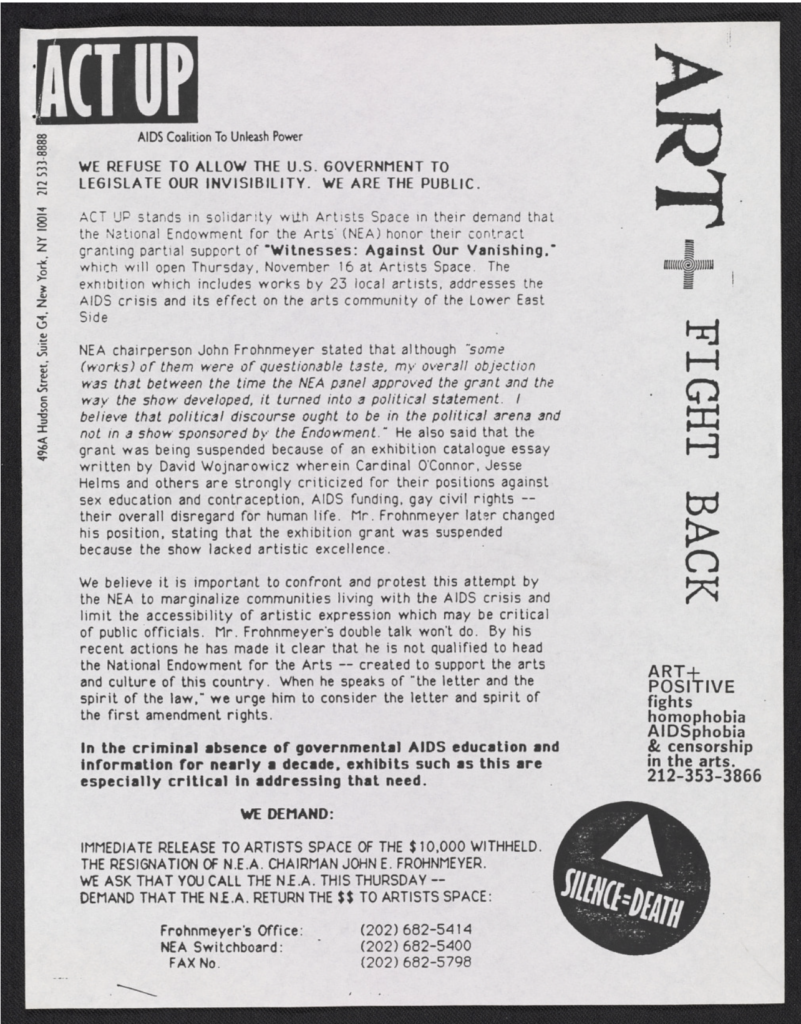
In response to David’s incendiary catalogue contribution, the NEA, then led by chairman John Frohnmayer, threatened to withdraw support, claiming the exhibit was too “political” (Frohnmayer 1989). The argument was based on the premise that the artwork being shown was “obscene” and therefore against the Helms Amendment, despite the show having not yet opened. As David remembered, Artists Space reacted to the catalogue first:
“I sent the essay down, and I get a phone call: ‘You have to change this’…Artists Space had brought it to Frohnmayer’s attention, had gone down there with this essay, although later they tried to backtrack and say it was just part of general interaction they’ve had with Frohnmayer from the beginning. Behind the scenes, he was asking for a return of funding for the show, and Artists Space was saying ‘No’” (Wojnarowicz 1990).
Phil Zwickler, Interview with David Wojnarowicz, 1989 on The Helms Amendment. Courtesy The Phil Zwickler Charitable and Memorial Foundation Trust.
“No gesture I can make could even approximate the violence of what these people have done. I’m not going to sit still and be silent about it.
” —David Wojnarowicz, 1989
David’s notes regarding “Witnesses” NEA confrontation and reminder of Cookie Mueller’s Memorial, November 10, 1989. From The David Wojnarowicz Papers in The Downtown Collection of Fales Library and Special Collections, New York University.
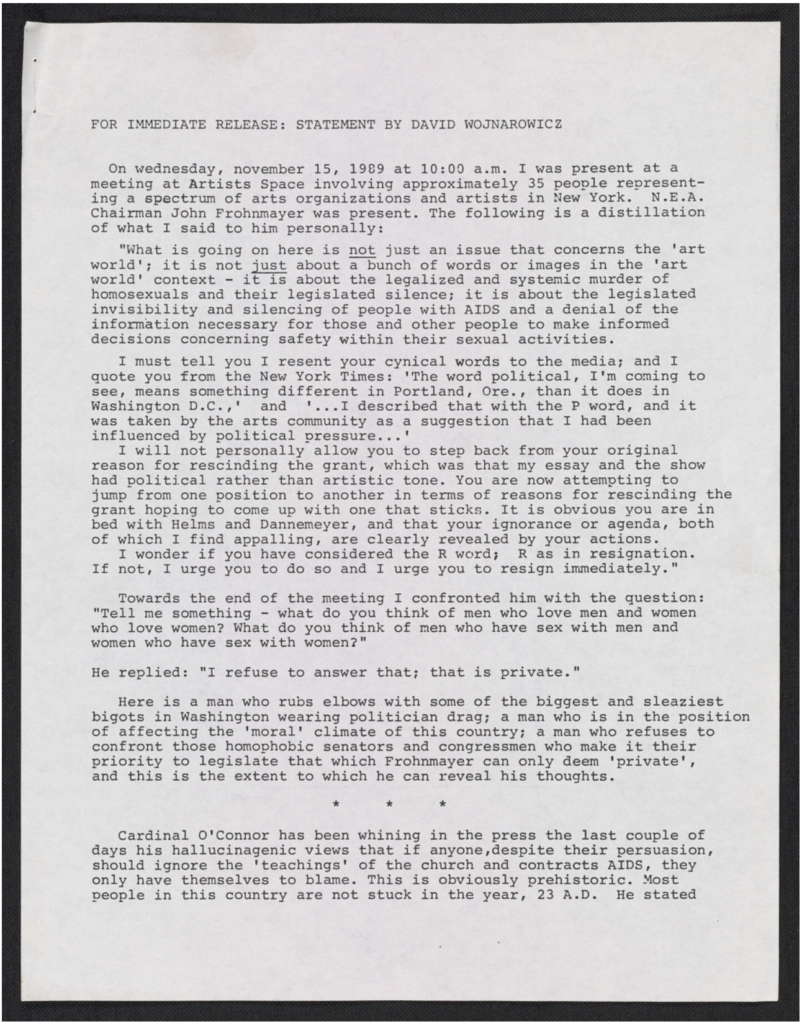
On November 15, the morning before Witnesses was scheduled to open, arts workers gathered at Artists Space to meet with Frohnmayer. Many of them, David included, read statements to Frohnmayer decrying his censorship policies:
“What is going on here is not just an issue that concerns the “art world”; it is not just about a bunch of words or images in the “art world” context—it is about the legalized and systematic murder of homosexuals and their legislated silence; it is about the legislated invisibility and silencing of people with AIDS and a denial of the information necessary for those and other people to make informed decisions concerning safety within their sexual activities….” (Wojnarowicz 1989).
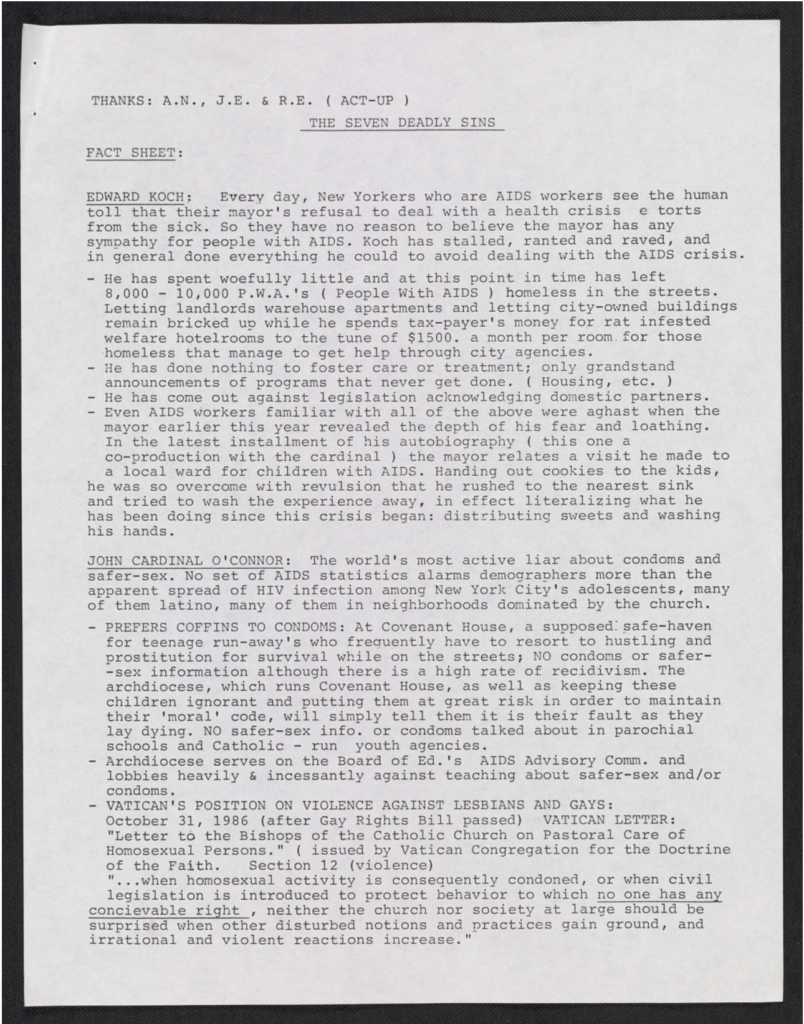
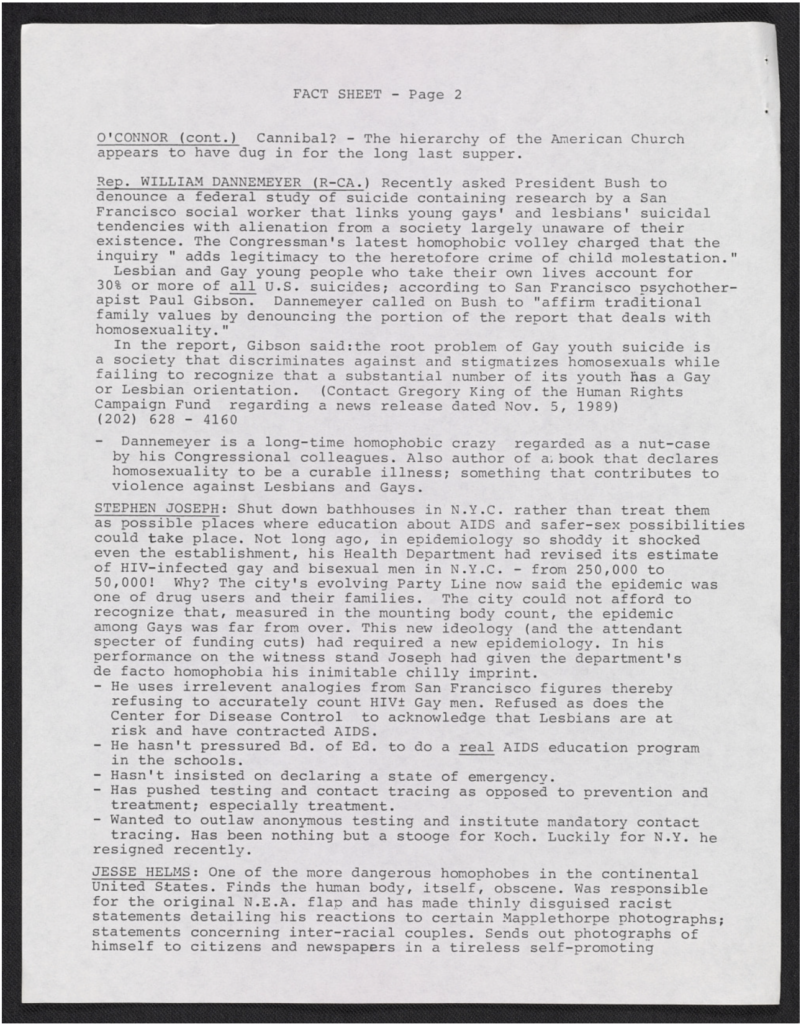
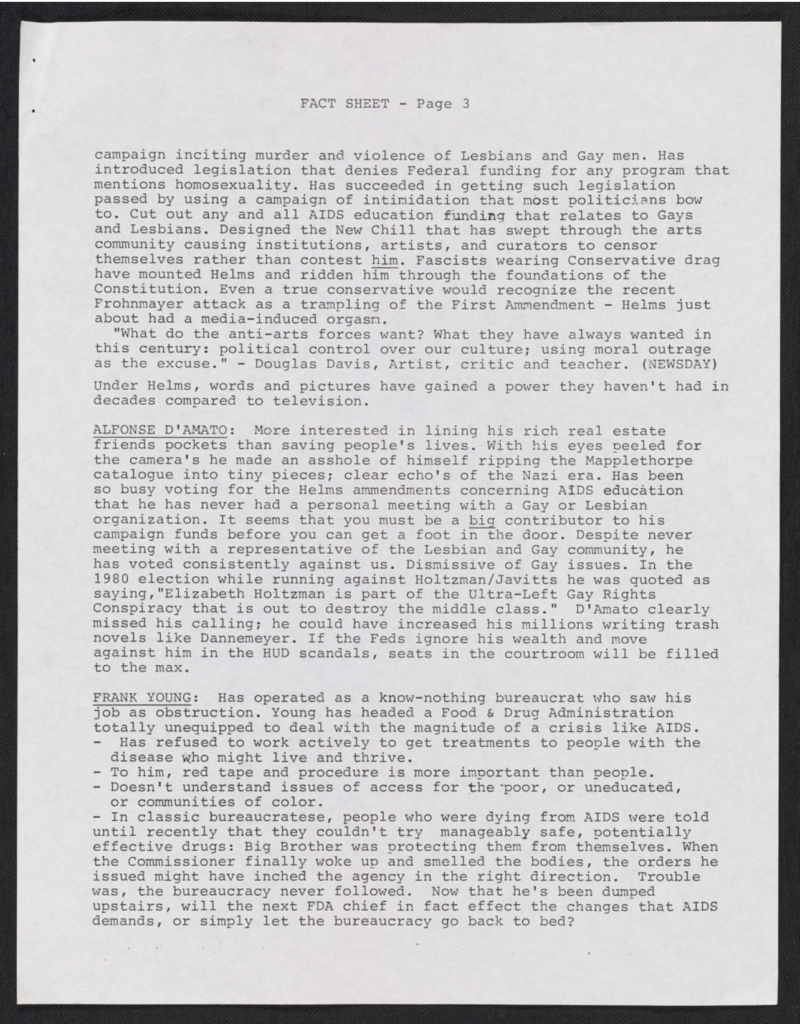
David’s notes from the Frohnmayer meeting are scribbled over in a loud reminder to attend Cookie Mueller’s memorial at St. Marks Church at 7:30 that evening. As documented by Zwickler, David stayed up the rest of that night writing a press release describing the confrontation and a fact sheet titled “The Seven Deadly Sins” with ACT UP compatriots Jim Eigo and Richard Elovich. He intended to slip the pages into the Witnesses catalogue alongside an ACT UP flyer. But the insert never made its way into the catalogue; exhausted from the controversy and Cookie’s funeral, David did not even attend the opening.
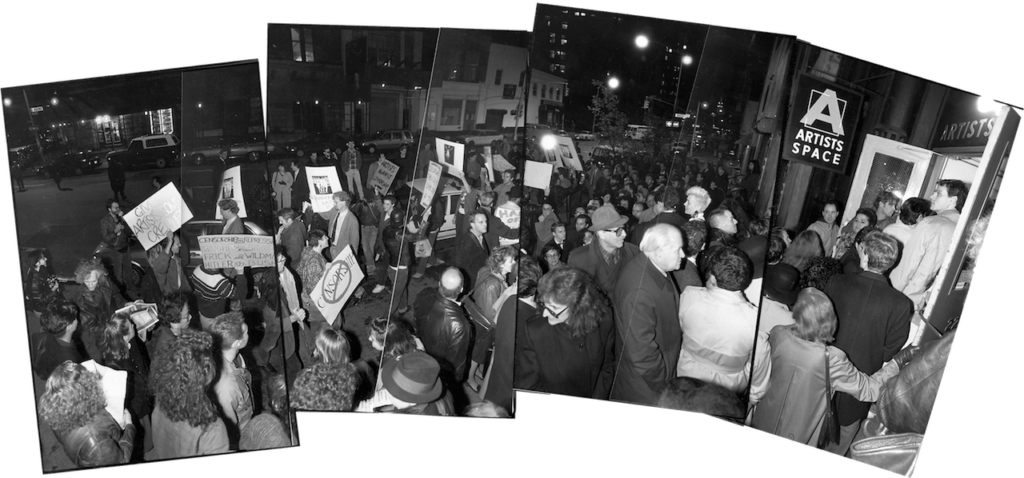
Art Positive collective demonstrators outside "Witnesses: Against Our Vanishing", organized by Nan Goldin, 1989. Artists Space, New York City. Photo courtesy of Thomas McGovern.
David Wojnarowicz in Ronald Reagan mask reading Dr. Seuss’ “Horton Hears a Who!” at exhibition “Witness: Against Our Vanishing”, organized by Nan Goldin, on November 29, 1989. Artists Space, New York City. Photo courtesy of Thomas McGovern.
In the end, the NEA and Artists Space reached an agreement on the day of the opening. The show remained funded by the NEA, while The Robert Mapplethorpe Foundation took up funding the catalogue. As a result of the controversy, the show received extensive national press coverage, garnering massive public attention before anyone could see it. Approximately 1500 people attended the show’s opening, while out front, several hundred members of the Art Positive collective demonstrated against The Helms Amendment.
As the show ran, Nan Goldin and author Barbara Barg organized a series of readings in the gallery to benefit ACT UP. Among them was a performance by David, who placed his text inside a copy of Dr. Seuss’s Horton Hears a Who! and read from it wearing a mask of Ronald Reagan. The program was radio broadcast on December 1 as part of the first Day Without Art: a national day of action, mourning, and remembrance organized by Visual AIDS. The exhibition closed on January 6, 1990. Extensive archives remain available online through Artists Space.
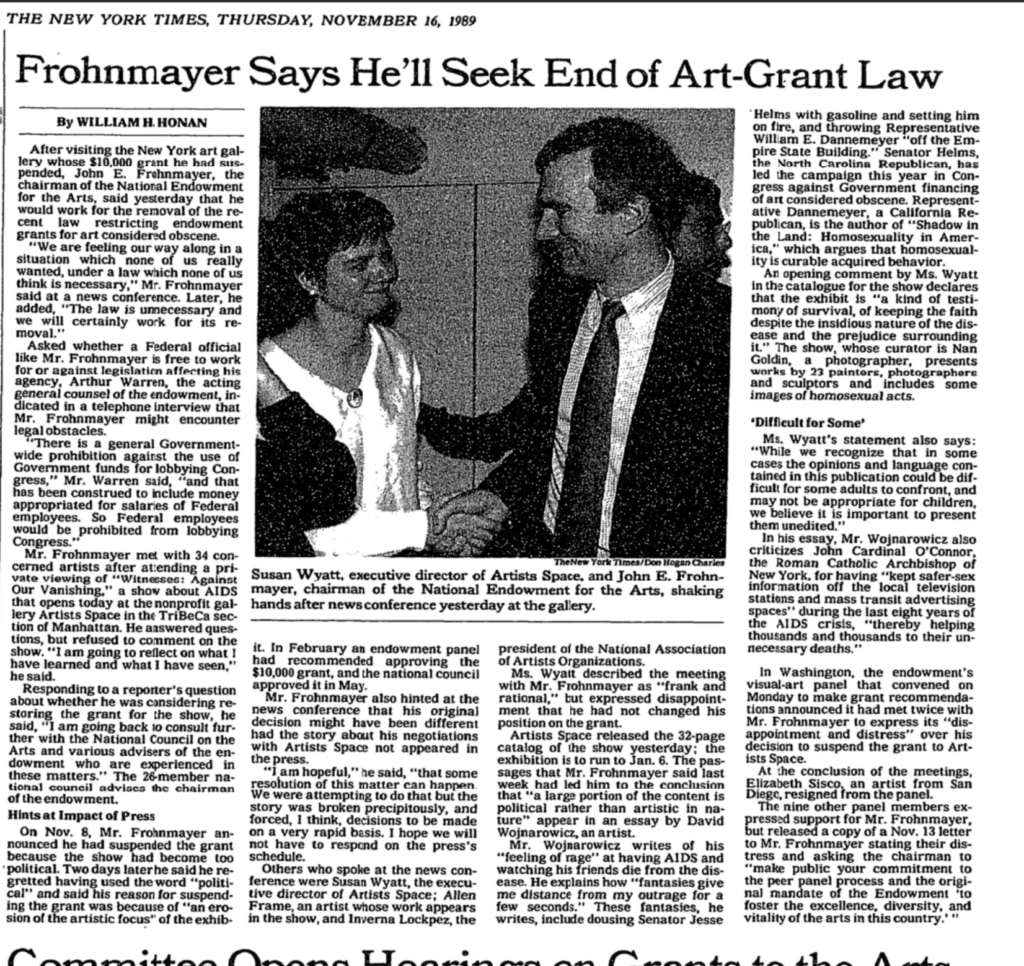
New York Times, November 16, 1989
New York Times, November 16, 1989
New York Times, November 16, 1989
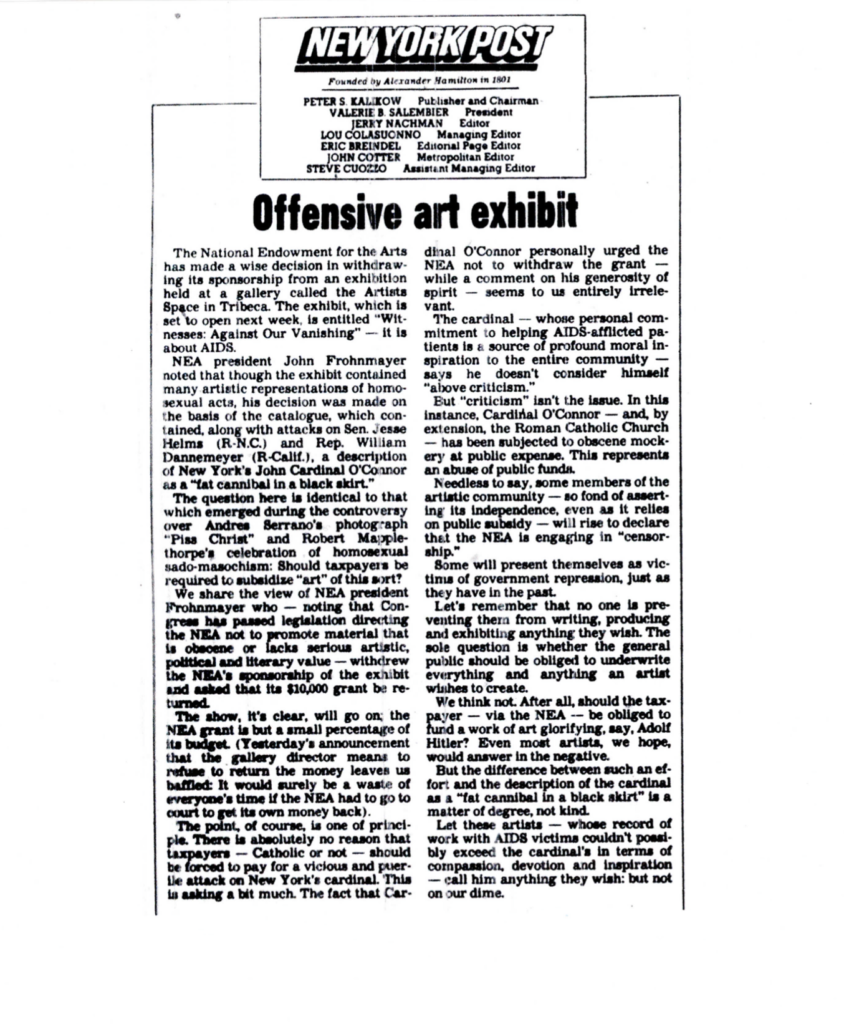
New York Post editorial opposing NEA funding for Artists Space "Witness Against Our Vanishing" show
“Art Emergency” produced by Fund for Innovative TV, 1989; camcorder correspondent Skip Blumberg. Courtesy Media Burn @mediaburnarchive.
At our present political moment, it is important to consider Witnesses for the work that it did in regards to respectful representation of victims of mass casualties. The artworks in the show constitute self-representative privacy, allowing a community to honor one another’s humanity and agency. The name of the exhibition itself emphasizes the necessity of bearing witness, while championing self-definition over intrusive analysis. In a moment when mass violence is neither hidden nor surprising, and images of crisis proliferate overwhelmingly, the artworks in Witnesses offer alternative frameworks to documentary practices that may be invasive or exploitative in their representations of victimization.
David Wojnarowicz’s last reading (text from his work “Untitled (Hujar Dead),” 1988-89), at the Drawing Center, 1992. Camera and production by James Wentzy and Dean Lance. Courtesy James Wentzy.
Witnesses’ controversiality lay in its presumed subject matter, rather than the appearance of artworks themselves, which had yet to be seen. The Helms Amendment’s broad definition of obscenity (the accusation levelled at the exhibition without further specificity) was revelatory of American conceptions of queerness as that which is non-normative and therefore unacceptable. The necessity of remembering and re-invoking Witnesses is a mortal one, as conceptions of queerness continue to shape whose presence is permitted in public and institutional spaces, whose lives are considered un-American, and by extension, who lives and who dies. David described such expressions of censorship as “a sign of fascism: to let people die, help people die, because you don’t agree with them on a spiritual level” (Wojnarowicz 1990). To this day, Witnesses stands against the violence of complacency, whether it be out of spiritual disagreement, fear of federal retaliation, or motivation for personal gain. Its continued relevance lies in its framing of remembrance as a form of resistance.
— Ray Atlas, David Wojnarowicz Foundation Fellow, Spring 2026
Frohnmayer, John. “Statement.” November 8, 1989. Artists Space Archive, Series I, Box 32, Folder 6.
Art about AIDS: Nan Goldin’s Exhibition Witnesses: Against Our Vanishing. Berlin/Boston: De Gruyter, 2016.
Miller v. California, 413 U.S. 15 (1973).
“In the Shadow of Forward Motion.” In In the Shadow of Forward Motion (exhibition catalogue), edited by P. P. O. W Gallery. New York: P.P.O.W Gallery, 1989.
Witnesses: Against Our Vanishing, edited by Nan Goldin. Essays by Nan Goldin, David Wojnarowicz, Cookie Mueller, and James Romberger. New York: Artists Space, 1989.
Carr, Cynthia. Fire in the Belly: The Life and Times of David Wojnarowicz. New York: Bloomsbury, 2012.